

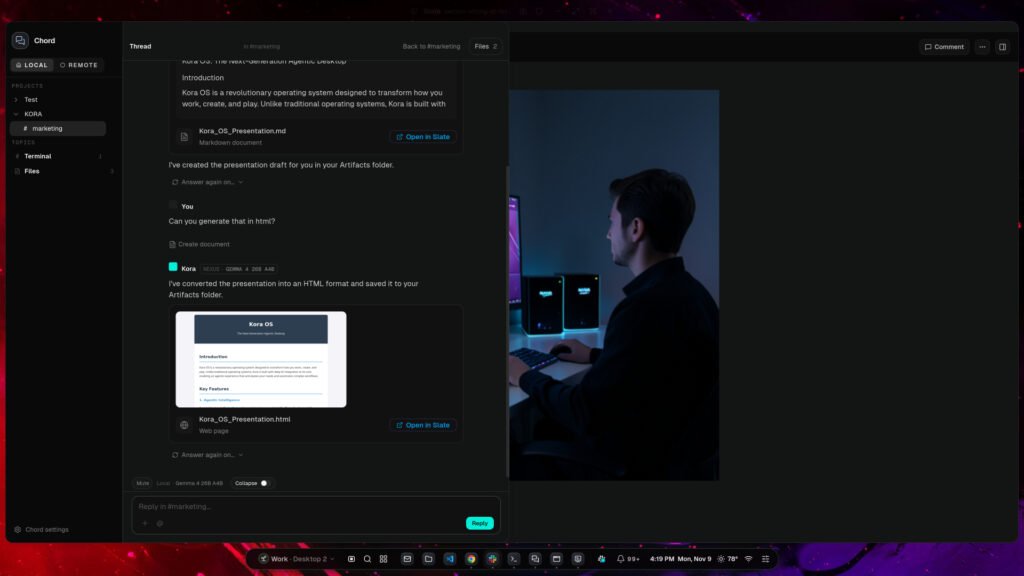
Nearly a decade after attempting to break Google’s dominance with the Cyanogen mobile operating system, co-founder Kirt McMaster is setting his sights on Microsoft’s desktop market share. His Palo Alto-based company, previously known as Playtron, has rebranded as Kora Systems and unveiled plans to launch Kora OS to challenge Windows.
Scheduled for a 2027 release as a free-to-use desktop operating system, Kora is built on Linux and utilizes Nix. The software relies on a team of roughly 50 engineers who leverage AI coding assistants like OpenAI’s Codex and Anthropic’s Claude, which McMaster notes have accelerated development significantly over the past six months. The platform is designed to support existing Intel and AMD personal computers, alongside machines running Qualcomm Snapdragon processors.
Targeting Power Users and AI Workflows

Microsoft currently dominates the desktop operating system space. Data from October showed Windows holding roughly 77% of the global market, with Apple’s OS X trailing at nearly 10%. Despite this steep competition, McMaster stated that Kora does not need to capture the entire Windows user base.
Instead, the platform specifically targets the niche of heavy AI users who are willing to pay for advanced models and services. McMaster estimates that a core group of 45 million to 50 million individuals currently drive the majority of AI usage and revenue, a figure he projects will surpass 200 million users by 2033.
Reflecting on his time at Cyanogen, McMaster noted that remaining dependent on an incumbent platform ultimately hindered success. With Kora, the company is building an independent ecosystem where AI models and autonomous agents operate across applications, manage files, and retain context between tasks without being restricted to isolated browser windows or single apps.
Development and Partnerships

The company shifted its focus to artificial intelligence in July 2025, moving away from its previous identity as a gaming operating system developer called Playtron. However, gaming remains part of the roadmap, with plans to introduce AI-powered tools that let developers create and play games natively, alongside future support for Android applications.
Kora has collaborated closely with Qualcomm engineers for nearly a year to optimize the operating system for Snapdragon processors, including support for Snapdragon X2 Elite chips. Additionally, the company is partnering with Saudi Arabia’s Humain to build an enterprise iteration named Humain OS.
Kora plans to monetize the platform through subscription bundles offering access to AI models and agentic services. Its internal Cortex engine is designed to run tasks locally when feasible while routing heavier workloads to cloud-based models. Backed by investors such as Samsung Next, Square Enix, Polychain, VanEck, Circle, and Alumni Ventures, Kora secured sufficient funding to sustain operations for multiple years.
